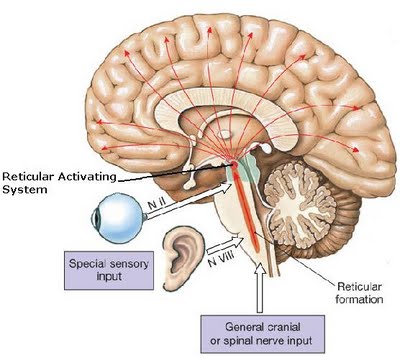
Looking into the biological domain of personality, some of the most interesting research is one the topic of Extraversion vs Introversion. This is something everyone can relate to in their everday activities, with the people we meet. On both extremities, we normally fall in between both, we will take a closer look on the differences between extroverted and introverted behaviours and what drives and motivates us.
The model of extraversion vs intraversion is measured normally using the Eysenck Personality Questionaire(EPQ). This questionaire will then determine which side of the table we sit on. The differences of these two is shown below;
Eysenck's theory is similar to Jung's theory meant in the same terms. The cause of extrovertedness or introvertedness in the biological domain is due to a neurological activity in a part of the brain called Ascending Reticular Activating Syndrome(ARAS).
It is shown that introverts have a high level of activity in the brain's ARAS, that is why, with such they avoid additional external stimulation. People strive to constantly keep the ARAS at an optimal level, that is why introverts work to decrease and avoid stimulation; extoverts works the opposite.
What motivates an extrovert and introvert? Personality is based on a two hypothesized brain systems, they are know as;
1. Behavioral Activation System(BAS)
- cues are rewards (regulates approach behavior, acts on impulses)
- sensation seeking behaviors = HIGH + Impulsivity
2. Behavioral Inhibition System(BIS)
- cues are punishment (regulates avoidant behavior, constant uncertainty)
- sensation seeking behaviors = LOW + Avoidance
By knowing what motivates us and which inclination arre we at, it will help us regulate behavior and choose our actions wisely with some predictability in the outcomes.
Monday, April 18, 2011
Personality : Defense Mechanism
Defense mechanisms are the protector of our Ego and the avenue to reduce anxiety and distress in a fight or flight situation. The picture below shows us the common 8 defense mechanisms;
Ego defenses are important in protecting our being and it's not necessarily unhealthy or negative. It helps us to get about and deal with threatening events in our daily lives. However, employing defenses at wrong times can create problems in life and overusing them can be very destructive to your social and mental wellbeing. More often than not, we come across over-defensive people who jumps at the slightest remark, taking it as an accusation. It's best that we always assess an event and situation before taking appropriate steps, now that we know the types of defense mechanisms.
Happy reading...
Saturday, April 16, 2011
Personality: Psychoanalytic Theory of Personality
When looking in to the Intrapsychic domain on psychology, the structure of personality developed by Sigmund Freud in his psychoanalysis theory comes to mind. Freud, a medical doctor born in Moravia, who started out in neurological research developed theories that portions of the human mind works outside the conscious awareness. In this domain, it is believed that we have 2 levels of personality, they are;
1. Unconscious - The major driving forces in which people are unable to control
2. Conscious - Awareness of everyday meanings
Freud termed this as instinct and where we draw our basic psychic energy that motivates all human activity. The unconscious parts of the mind lies unacceptable information, hidden from conscious view; these are memories, feelings, thoughts, or urges that are troubling and distasteful. These feelings dwells in the unconscious mind and is controlled by the conscious plane. Memories that are extremely distressing and painful is being pushed into the subconcious plane.
According to Freud, human basic structure of personality looks something like this;
For the benefit of understanding better, here's a brief description of ID, EGO, and Super Ego;
ID - defined as our inner child and the reservoir of psychich enery. ID oftens demands instant gratification to all our wants. It functions on primal urges and according to pleasure principles.
SUPEREGO - the upholder of societal values and ideals, the superego internalized ideals of society, moral and values that we have been brought up with. This is the part where functions to make us feel guilty, ashamed, and embarrassed when we do something wrong or pride when we do something right. Like ID, SUPEREGO practices instant gratification for high virtues and constantly pounding for the highest values into our subconscious. It's like an angel constantly whispering into your ears.
EGO - the executive of personality, which functions as the regulator that works to redirect pressure produced by IT and SUPEREGO instincts into acceptable or least problematic outcomes. For example, teasing someone is more acceptable than hitting them and it perhaps fulfill some aggressive urges but it's not all that simple as some urges are simply unacceptable in society.
More often, we tend to have a conflict within ourselves in everyday events. For instance, dissatisfaction with our bosses or colleagues. This creates a conflict between our ID and SUPEREGO and this causes us to develop anxiety. From anxiety and stressful events, we come up with what is known as defense mechanisms.
Defense mechanisms help us to cope with these anxiety situations and defends us from severe conflicts that evokes anxiety. This is where the EGO function comes to play, to balance out the id and superego and ultimately reduces anxiety in a situation that is threatening and poses danger to us. We can say that defense mechanisms serves 2 functions, which is to protect the ego and to minimize distress and anxiety.
Tuesday, April 12, 2011
Personality: Field Dependence & Field Independence
Some of the most interesting areas when looking into the cognitive/experiential domain of personality is perception, interpretation, and conscious goals. All this in the cognitive domain contributes to the way a person making sense or explaining various events that occurs to them, mostly by associating past experience or something of similar sorts. People mostly have different views towards events, for example, when you get involved in an accident. Some people may view it as a result of poor road conditions but some may view it as poor driving skill.
People often assumes that the reality out there is exact duplicate of what their perception of facts. In this case, it is untrue because a person can only create perception based on their mental representation but bearing in mind, that another person perceives the same reality differently. In this topic, we will further explore the processes and outcomes of field dependence and field independence of personality in the cognitive domain.
Some of the traits of field independence and field dependence types personality can be explained and compared in the table below;
Because of the differences in personalities, there is a blaring contrast on how people perceive and react to an event. Take for example the image below,
Some people on first glance will see an old looking lady but other people would see the back of a young woman.
Professor Herman Witkin devoted 30 years studying differences in perceptual styles. His research have founded certain traits within personality that determines whether a person is field independent or otherwise. Witkin devised a test called the Embedded Figures Test(EFT), this test shows that field dependent people have difficulty in discovering embedded images in comparison to field independent people who can quickly spot these images. This is because field independent people are able to see objects independently from the background. Scores and measures on field independence/dependence is stable over time and have consequences on educational and interpersonal relations (Witkin, 1977).
What type of personality are you? Take a test and see how long does it take to find all embedded images:
Solution:
Another research on field independence/dependence which correlates with the interpersonal relations, Witkin and Goodenough(1977) finds that field dependent people as might be predicted, relies on social information and frequently ask others opinion. They show strong interest in other people, attracted to social situations, likes getting physically close and get along well with others. In contrary, field independent people displays a more impersonal and detached orientation towards other. They keep distance from social situations, keep their distance from people and are not interested in others opinion.
Finally, lets look at the motivations that drives these two types of people;
By having an understanding between these two fields, we can reflect on which types of field do we belong to and by knowing, we can decide on issues such as career paths and understanding other people in our daily interactions.
Monday, April 11, 2011
Personality & Social Interactions
When talking about personality psychology, one of the important areas to look into are social interactions. Social interactions plays an important role in the shaping of one's personality. Zooming in, we'll find 3 mechanisms that governs social interaction. They are;
1. Selection
We select people and environment we want to interact and social interactions which we expose ourselves to. A good example would be mate selecting, people worldwide look for mates that are dependable, emotionally stable and have a pleasing disposition. We also tend to select mates who are similar in personality with us, a process known as selective mating. These are favorable characteristics desired in a marriage that is found in a study carried out by Buss, 1990. The study was carried out on 10,000 participants from 37 samples, 33 countries, 6 continents, and 5 islands. The idea of complementary where people popularly believe that opposites attract, does not have empirical support. According to a research by Botwin, 1997; people are usually married to people who are similar in personality to their own. But, do people get the mate that they want? Unfortunately, we don't always get the mate that we want. Those who fail to get what they want and ends up with mates who are emotionally unstable or disagreeable tend to be unhappy and ends up in a break up or in a divorce than those who succeed in getting what they want. Personality, plays to key role in the selection process which is, determining mates whom we desire and whom we are attracted. Secondly, affecting satisfaction with one's mate which will result in either successful selection or determine the selective break up of couples. In the selection process, we also look further than just mate selection. The personality can also affect our selection process in terms of selecting risky situations. For example, a shy personality person may always try to avoid events that will lead them to social interactions because to them, it's a risky situation. Research have been done on personality and the selection of risky situations. Shyness also affects a person is willing to select risky situations in the form of gambles (Addison & Schmidt, 1999). An experiment done by Cheek (1983) on participants who were given choices to pick a gamble. One with high odds of winning with low payouts and other with low odds but high payouts, there was a big contrast in the result between shy and non-shy women. Non-shy women chose the riskier bets and vice-versa with the shy women. During the experiment, shy participants shows larger increase in heart rates, suggesting that fear might have led them to avoid risky gambles.
2. Evocation
Evocation is a second class process that sets in motion once we select others to occupy in our social environment. Evocation may be defined as features of personality elicit reactions from others or in layman terms getting a certain emotional feeling or reaction from other people, parallel to our own personality type. A good example would be, have you come across someone you know who is an aggressive person and that person tends to make you personally feel hostile and somewhat on the hot side? Well, that means that person has successfully evoked you to fit his/her social environment. Another good example of evocation would be, when somebody bumps into you in a mall. An aggressive personality person would interpret the incident as intentional and hostile, an agreeable person would interpret the incident as an accident. There are two ways a personality plays a role in evoking conflict, especially in a close relationship. A personality of one partner which, for example, dominant and forceful may evoke upset in the partner or a low conscientious partner with poor tidiness, messing up the house causing his wife to get upset. Second, would be a person elicit actions from their partner and in turn upsetting the original elicitor. For example, an aggressive husband might elicit silent treatment from his spouse and then getting upset because she wouldn't speak to him. Another interesting phenomenon in evocation is Expectancy Confirmation. This is where a person's belief of the personality of others causes them to evoke others, consistent with their initial beliefs. It is sort of a self fulfilling prophecy, for example, when you are told the person that is joining your group is an aggressive person and when introduced, there will be a tendency that you will evoke hostility in order to confirm what you believed that person to be. Through this process, people who knows you might unknowingly evoke in you behaviors that confirms their beliefs from time to time making it difficult if you are looking to make a change.
3. Manipulation
Not necessarily a negative thing, we tend to naturally manipulate to obtain what we want by intentionally influencing and exploiting others. Depending on personality, there are several manipulation tactics used in influencing others such as, charm, silent treatments, regression, coercion, reasoning and self-abasement. The usage of manipulation tactics is pretty much equal between men and women, except the regression tactic such as prolonged crying and whining which is used more often by women. Personality predictors in manipulation process is hinged on The Machiavellian Personality which is from the opinions of Niccolo Machiavelli separates two categories; "Low Mach" and "High Mach". Low Mach's have a worldview of empathy, trusting, clear moral values and views human nature are basically good. On the other hand, High Mach's worldviews are of cynical world, doesn't trust people, morality is a gray line, lack empathy, and views human nature as evil at any given opportunity. Generally, High Mach individuals will employ any tactics to get ahead and blatantly lie to escape consequences. Not only do high Machs lie and betray others trust more than low Machs, but there is also evidence that they make more believable liars (Exline et al., 1970; Geis & Moon, 1981). Manipulative tactics used by high Machs also extends to romantic and sexual domains, they are likely to feign love for sex. Nevertheless, high Machs runs into certain risks such as revenge and retaliation by those who were exploited.
Subscribe to:
Posts (Atom)