In the adjustment domain of personality psychology, focuses here defers from the other domains. The other 5 domains discusses the collection of specific explaination of personality that causes individual personality differences. In this domain, we focus on adjustment because personality help us adjust to the daily demands and challenges of life. Major themes of this domain is physical and mental health. We will look into the the models of personality-illness connection and stress. Stress, the subjective feeling that is experienced by individuals produced by uncontrollable or even threatening events. However, stress is not in the even or situation but rather in how people choose to respond towards a particular situation.
INTERACTIONAL MODEL
Suggest that events that occurs in people's lives relies on personality factor of an individual on the ability to cope and personality effects on how people respond to an event. It is called interactional model because it talks of the relationship on how personalities moderate between stress and illness. Example of such relationship is when a student gets sick when exam approaches and happens particularly during stressful moments. Although we are exposed daily to microbes, it is believed that in the personality that determines how vunerable we are to falling sick. The student falls sick because of staying up too late because of anxiety, refusing to sleep, and does everything that prevents recovery unconsciously.
TRANSACTIONAL MODEL
The transactional model can be termed as the more complex and realistic model developed out of the interactional model. It serves three potential effects:
1. it can influence coping(as in interactional model)
2. it can influence how an individual appraise and interprets an event
3. it can influence the event and situation itself(outcomes of a personality)
In effect, this model views on how a person's interpretation of an event. Remember, earlier I mentioned that a stressful situation or event is not the event itself but rather how it's being interpreted as. For instance, when getting stuck in traffic, some people finds it a major frustration and responds with worry, stress, and anxiety but another person might look at it as an opportunity to relax, self-reflection time, listening to music, etc... .This is how a personality plays a role in the interpretation of an event and also how personality can impact and event itself. People also creates situation through choice and actions, such as personalities that evokes situation. In other words, events doesn't just influence people, people too, influence events in a reciprocal manner. In contrary to interactional model, personality does not directly influence relationship between stress and illness but rather affects indirectly through promoting health degrading behaviours.
PREDISPOSITION MODEL
A model which stands differently that the previous 2 models. The other models are variations of the same themes but this model talks about the personality and illness are expressions of an underlying predispostion such as genetics. An example would be, enhanced sympathetic nervous system reactivity may be the cause of illness, behaviours, and emotions that makes a person neurotic. However, not much systematic study conducted on this model but there are associations found between illness and personality linked through underlying predisposition. Genetics may also likely be the cause of people developing drug addiction.
On a final note, we look at the illness model behaviour. It's not a model per se, but more of a model of illness behaviour. It's a degree which personality influences a person's perception to bodily sensations and interprets the sensations as illness. Illness behaviours are related to actual illness and sometimes, made believe illness. Due to personality, some people may try to fight illness by force but others, a simple bodily sensation may cause a person to take actions like visiting the physician although there's really nothing wrong with them. In this case, symptoms are normally more towards self-reports in illness behaviours. These however, are determined by a person perceives and labels their bodily sensations.
Looking at the models in this domain, we can now understand better how our personalities are related to our health and the importance of adjusting and coping with illness. It provokes us to ask ourselves questions, such as, "Am I really sick or just overly sensitive?" or "Is my personality affecting my work habits?". With that, we can work to tweak aspects of our lives to a personal well-being improvement. :)
Wednesday, April 20, 2011
Tuesday, April 19, 2011
Personality : Finding Depression in Sex Difference
When looking into depression, we often see it hand in hand with personality types, gender differences and the FFM. Let's look into how gender differences play out depression and what possible outcomes could arise.
Studies has shown that there is no differences in depression at childhood. Children is well adjusted and unable to understand depression as their worldviews are simple and abstract. However, after puberty, woman show two to three times depression rate than man (Hoyenga & Hoyenga, 1993). This is probably due to the fact, that women in gender roles expectation in many cultures are expected to behave in an acceptable manner and inability to project emotional dissatisfaction physically causes onsets of depression.
It is also founded that roughly 25% of women have at least on depressive episode in their lifetime compared to only 10% of men in their lifetime.
Largest differences in depression shows between ages 18 – 44. After that both sexes starts to converge and see a lesser depression rate.
Below is a table that shows how different gender cope and act out in a depressive state.
By having an idea on how depression affects different genders, we can see tell tale signs of depression and perhaps help our friends or family to cope with such situation when it arises.
Studies has shown that there is no differences in depression at childhood. Children is well adjusted and unable to understand depression as their worldviews are simple and abstract. However, after puberty, woman show two to three times depression rate than man (Hoyenga & Hoyenga, 1993). This is probably due to the fact, that women in gender roles expectation in many cultures are expected to behave in an acceptable manner and inability to project emotional dissatisfaction physically causes onsets of depression.
It is also founded that roughly 25% of women have at least on depressive episode in their lifetime compared to only 10% of men in their lifetime.
Largest differences in depression shows between ages 18 – 44. After that both sexes starts to converge and see a lesser depression rate.
Below is a table that shows how different gender cope and act out in a depressive state.
| Woman | Man |
| Excessive eating | Avoid eating |
| Cry | Aggressive behaviour |
| Likely, seek treatment | Men simply to miss work |
| Nervous activity | Inactivity |
| Hurt Feelings, decline self-esteem | Socially withdrawn, experience aches and pains |
| Suicide attempts “non-fatal” | Suicide “successfully” |
By having an idea on how depression affects different genders, we can see tell tale signs of depression and perhaps help our friends or family to cope with such situation when it arises.
Personality : Sex, Gender and Personality
Finding differences of gender in the 5 factor model
- 3 facets of extraversion was examined for sex difference; gregariousness, assertiveness and activity:
- Gregariousness is defined as fond of companies and sociable. Woman is found to score higher than men. Personality study on 50 difference cultures revealed a small gender differences (McCrae et. Al., 2005b)
- Assertiveness is defined as confidence and forceful personality, shows men scored highly and have a medium difference from women. This is probable due to social status, where men tend to value dominance and power than woman do. This is reflected in a study of 127 samples in 70 countries (Schwartz & Rebel, 2005). This medium-size sex difference in assertiveness may show up in social behaviour in group context. This is reflected in a number of studies that men interrupt others in conversation more than woman in a mixed-sex group (Hoyenga & Hoyenga, 1993)
- Activity shows men scored slightly over women. This is probable due to the high assertiveness and wanting dominance and value of social status and power
Agreeableness- 2 facts of agreeableness is examined ; Trust and tender-mindedness
- A study on 50 cultures revealed a small to medium gender difference, where woman score higher than men (McCrae et. Al. 2005; Schmitt et. al,2008)
- Women tend to me more trusting than men and have empathy and sympathy for those who are downtrodden
- Men mostly stand on the opposite end which is aggressiveness. This shows in personality test, in aggressive fantasies and in actual measures of behaviour (Hyde, 1986)
- However, after 50, aggressiveness in men and woman starts to decline
Conscientiousness- The 50 culture study revealed negligible sex difference on level of conscientiousness (McCrae et. al, 2005 b)
- Only one facet is examined which is order, where woman score slightly higher than men
- Men and woman are essentially the same on this dimension
- Small difference in keeping home order in a marriage may result in large number of arguments
Emotional Stability
- The 50 culture study revealed the largest sex difference, where woman are moderately lower in emotional stability than men on this dimension (McCrae et. al. 2005b)
- Facets that was measured on was anxiety and impulsiveness
- Woman scored highly on the anxiety label, whereas, men scored slightly higher on impulsiveness
Openness
- Essentially no sex differences in this dimension (McCrae et. al, 2005b)
- Facet of openness examined on a label called ideas, which refers to range of thoughts, or concepts a person entertains
Monday, April 18, 2011
Personality: Extraversion vs Introversion
Looking into the biological domain of personality, some of the most interesting research is one the topic of Extraversion vs Introversion. This is something everyone can relate to in their everday activities, with the people we meet. On both extremities, we normally fall in between both, we will take a closer look on the differences between extroverted and introverted behaviours and what drives and motivates us.
The model of extraversion vs intraversion is measured normally using the Eysenck Personality Questionaire(EPQ). This questionaire will then determine which side of the table we sit on. The differences of these two is shown below;
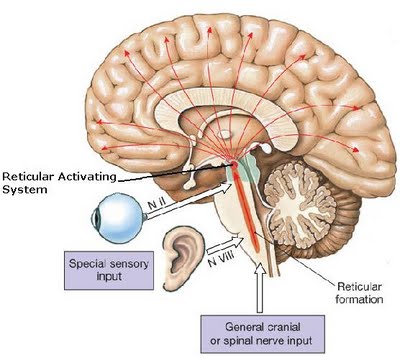
Eysenck's theory is similar to Jung's theory meant in the same terms. The cause of extrovertedness or introvertedness in the biological domain is due to a neurological activity in a part of the brain called Ascending Reticular Activating Syndrome(ARAS).
It is shown that introverts have a high level of activity in the brain's ARAS, that is why, with such they avoid additional external stimulation. People strive to constantly keep the ARAS at an optimal level, that is why introverts work to decrease and avoid stimulation; extoverts works the opposite.
What motivates an extrovert and introvert? Personality is based on a two hypothesized brain systems, they are know as;
1. Behavioral Activation System(BAS)
- cues are rewards (regulates approach behavior, acts on impulses)
- sensation seeking behaviors = HIGH + Impulsivity
2. Behavioral Inhibition System(BIS)
- cues are punishment (regulates avoidant behavior, constant uncertainty)
- sensation seeking behaviors = LOW + Avoidance
By knowing what motivates us and which inclination arre we at, it will help us regulate behavior and choose our actions wisely with some predictability in the outcomes.
Personality : Defense Mechanism
Defense mechanisms are the protector of our Ego and the avenue to reduce anxiety and distress in a fight or flight situation. The picture below shows us the common 8 defense mechanisms;
Ego defenses are important in protecting our being and it's not necessarily unhealthy or negative. It helps us to get about and deal with threatening events in our daily lives. However, employing defenses at wrong times can create problems in life and overusing them can be very destructive to your social and mental wellbeing. More often than not, we come across over-defensive people who jumps at the slightest remark, taking it as an accusation. It's best that we always assess an event and situation before taking appropriate steps, now that we know the types of defense mechanisms.
Happy reading...
Subscribe to:
Posts (Atom)